Huan-Huan Zhao, Xu-GangZhang, and Peng-Fei Xu*
https://doi.org/10.1021/acs.orglett.6c02334
Abstract
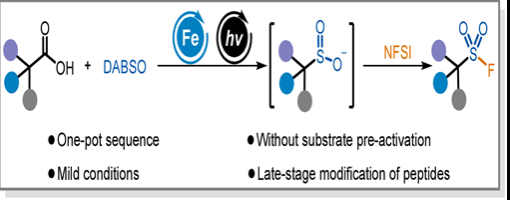
In this report, we describe an LMCT-based iron-catalyzed strategy for the decarboxylative fluorosulfonylation of aliphatic carboxylic acids, using DABSO as the SO2 source and NFSI as the fluorine reagent. The Fe(III)/Fe(II) redox cycle enables simultaneous activation of the carboxylic acid and reduction of the sulfonyl radical. This strategy efficiently generates sulfonyl fluorides under mild conditions and facilitates late-stage functionalization of drugs, natural products, and peptides.
Zhi Lei, Hao Tang, Heng Zhang, Xu-Gang Zhang*, Peng-Fei Xu*
https://doi.org/10.1016/j.apsusc.2026.167873
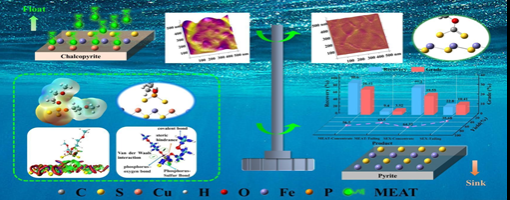
The effective flotation separation of chalcopyrite and pyrite remains a significant challenge due to their similar surface properties, necessitating the design of novel collectors with high chemical selectivity. This study systematically investigated the effects of the novel collector O, O′-bis(2-methoxyethyl) ammonium dithiophosphate (MEAT) on the flotation separation of chalcopyrite and pyrite. Micro-flotation tests reveal that chalcopyrite can be effectively separated from pyrite at pH 8 using 10−4 mol/L of MEAT, with the recovery margin reaching as high as 77.65%. SEM, AFM, and TEM analyses demonstrated that MEAT substantially altered the structural morphology of chalcopyrite, while exerting minimal impact on pyrite. Zeta potential, FTIR, XPS, and total density of states (TDOS) analyses revealed new peaks on the MEAT-treated chalcopyrite, confirming its chemical adsorption via Cu–S bond formation. The interaction region indicator (IRI) demonstrated that, compared to sodium ethyl xanthogenate (SEX), MEAT exhibits not only favorable charge distribution and intramolecular interactions but also stronger chemical forces toward chalcopyrite. Density functional theory (DFT) further verifies that MEAT possesses a more negative adsorption energy on chalcopyrite, resulting in a more stable adsorption configuration. This study provides new insights into the mechanism of action of collectors in the flotation separation of copper-iron minerals.
Heng Zhang , Zhi Lei, Hao Tang, Hao-Ran Wu, Xu-Gang Zhang*, Peng-Fei Xu*
https://doi.org/10.1016/j.mineng.2026.110660
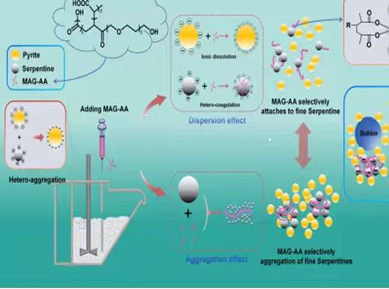
This study addresses the adverse effects of fine serpentine gangue on pyrite flotation, which mainly arise from hetero-aggregation and mechanical entrainment. A novel modular depressant, maleic anhydride-glycol ester-acrylic acid (MAG-AA), was designed by utilizing maleic anhydride as a linker to incorporate selective adsorption groups and aggregation groups into a single molecule. This design enables selective adsorption on serpentine and promotes its flocculation, thereby weakening its adverse effects on pyrite flotation. Flotation test results showed that the pyrite recovery significantly increased and attained 91 % when 4 mg/L MAG-AA was used at a pH 8.5. FTIR results confirmed strong adsorption of MAG-AA on serpentine. Analyses of zeta potential, XPS, and SEM-EDS further demonstrated that COO⁻ groups in MAG-AA chemically interact with the serpentine surface, causing a shift in its surface charge to a more negative state and suppressing hetero-aggregation with pyrite. In addition, microscopy and sedimentation tests have revealed that MAG-AA effectively induces serpentine aggregation due to its structural flocculation groups. Therefore, MAG-AA simultaneously achieves selective depression and flocculation of serpentine, which reduces both surface contamination and entrainment, thereby enabling effective pyrite-serpentine separation.
Heng Zhang, Hao Tang, Zhi Lei, Xu-Gang Zhang*, Peng-Fei Xu*
https://doi.org/10.1016/j.colsurfa.2026.141282
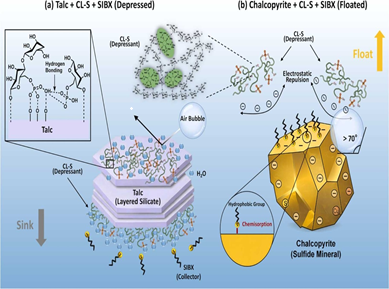
Separating chalcopyrite from naturally hydrophobic magnesium silicate gangue, especially talc, remains challenging in copper sulfide flotation. In this study, sodium phytate cross-linked starch (CL-S) was synthesized as an environmentally benign depressant for selective talc depression. Micro-flotation tests showed that CL-S strongly depressed talc over a wide pH range (pH 4–10), while exerting limited influence on chalcopyrite recovery. In artificial mixed-mineral flotation, CL-S produced a concentrate with a Cu grade of 26.32% and a Cu recovery of 91.19%, while reducing the MgO content to 5.23%. This performance was better than that obtained with conventional depressants such as carboxymethyl cellulose (CMC) and guar gum under the same conditions. Surface analyses indicated that phytate-derived hydroxyl and phosphate groups support preferential physical adsorption of CL-S on talc, mainly through hydrogen bonding, van der Waals forces, and hydration effects. This adsorption was consistent with increased surface hydrophilicity, as shown by the decrease in talc contact angle from 87.62° to 38.61°. In contrast, CL-S adsorption on chalcopyrite was limited, probably because of unfavorable electrostatic interactions and fewer oxygen-containing surface sites. These findings suggest that CL-S is a promising polysaccharide depressant for beneficiation of copper sulfide ores containing talc.
Hui Zhang, Ke-Chun Wang, Wei-Jun Cao, Ying-Jie Wang, Peng-Fei Xu*
https://doi.org/10.1002/ejoc.70504
Abstract
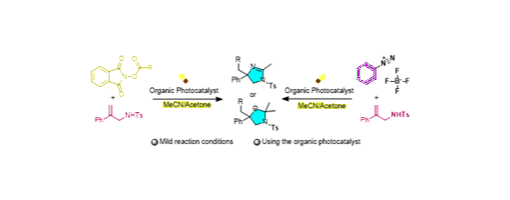
Herein, we report a synthetic strategy that relies on a self-developed organic photocatalyst for the efficient construction of imidazolines and oxazolidines. Using readily available 4-methyl-N-(2-phenylallyl)benzenesulfonamide alkenes and redox-active esters (RAEs) or aryl diazonium tetrafluoroborates as substrates, the reaction proceeds in acetonitrile/acetone via photoredox-initiated radical addition followed by ionic cyclization, which involves the formation of a key nitrilium/imidate-type ionic intermediate. This transformation features mild reaction conditions and facile operation, not only expanding the application scope of the developed photocatalyst, but also providing a practical technical platform for the photocatalytic synthesis of structurally diverse bioactive molecules containing imidazoline and oxazolidine motifs.
Teng-Fei Xiao, Ming-Ming Li, Dong Xie, Yu-Cheng Gu, Pan-Pan Zhou*, Guo-Qiang Xu* & Peng-Fei Xu*
https://doi.org/10.1007/s11426-025-3052-7
Abstract
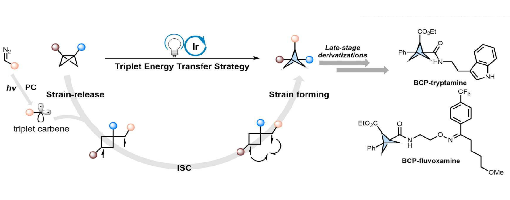
Bicyclo[1.1.1]pentanes (BCPs) have emerged as valuable saturated bioisosteres of arenes in drug discovery. While 1,3-disubstituted BCPs are increasingly accessible, the pharmaceutical value of 2-substituted BCPs as replacements for MIMIC ortho-/meta-substituted arene rings, modular access to these scaffolds remains elusive. Here we report a visible-light-mediated σ-bond insertion strategy that exploits triplet energy transfer catalysis to convert readily available bicyclo[1.1.0]butanes (BCBs) into 2-substituted BCPs. The reaction proceeds via triplet carbene intermediates that engage in regioselective insertion into the central C–C σ-bond of BCBs. Mechanistic studies, supported by radical trapping experiments, Stern-Volmer analysis, light-dependence assays, and density functional theory (DFT) calculations, reveal a radical mechanism. The key challenges in this transformation include: controlling the highly reactive radical intermediates; achieving regioselective addition to the highly strained BCB (strain energy: 53.8 kcal/mol), and reconstructing the highly strained BCP ring (strain energy: 54.4 kcal/mol) during radical coupling.
Hui Zhang, Ying-Jie Wang, Hao-Wen Jiang,* and Peng-Fei Xu*
https://doi.org/10.1021/acs.orglett.5c05168
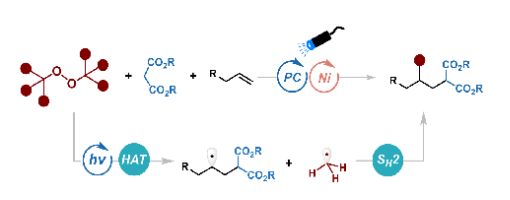
ABSTRACT: Herein, we report a strategy for the methylalkylation of unactivated alkenes via synergistic photoredox/nickel catalysis. This mild transformation employs di-tert-butyl peroxide (DTBP) as a bifunctional reagent, which serves simultaneously as a hydrogen atom transfer (HAT) reagent and a source of methyl radical, thereby facilitating the coupling of malonate-derived radicals with alkenes. By integrating HAT with radical selectivity control, the method enables the formation of two C(sp 3 ) bonds in a single synthetic operation, offering a streamlined route to valuable three-dimensional scaffolds.
Ai-Lian Wang, Yi-Fan Yao, Xu-Gang Zhang,* and Peng-Fei Xu*
https://doi.org/10.1021/acs.orglett.5c04773
ABSTRACT:
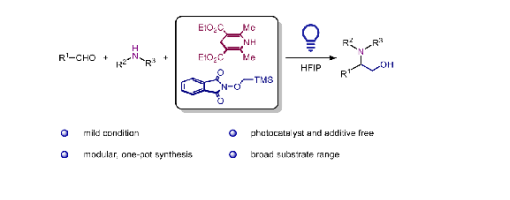
Herein, we report a catalyst-free, photosensitized strategy for synthesizing 1,2-amino alcohols. This transformation proceeds via the addition of an α-hydroxymethyl radical to an in situ-generated alkyliminium ion. The α-hydroxymethyl radical is formed by the radical Brook rearrangement of a (trimethylsilyl)- methoxy radical generated from an electron donor-acceptor (EDA) complex between Hantzsch ester and N-((trimethylsilyl)- methoxy)phthalimide. Therefore, this Mannich-type reaction establishes an additive-free, modular, and simple approach for the synthesis of 1,2-amino alcohols.
Teng-Fei Xiao, Ke-Rui Jian, Yu-Cheng Gu, Guo-Qiang Xu and Peng-Fei Xu
https://doi.org/10.1039/D5SC06987D
ABSTRACT
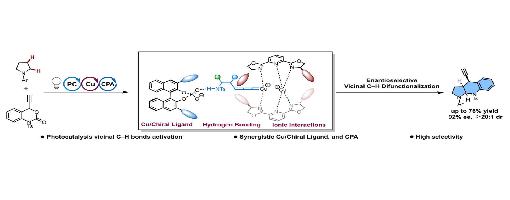
Existing strategies are typically limited to modifying a C–H site (a or b-position) of saturated cyclic amines, but the asymmetric difunctionalization of vicinal C–H bonds remains a formidable challenge. To address this challenge, this work introduces a synergistic catalytic system that merges visible-light photocatalysis with asymmetric copper and chiral phosphoric acid catalysis. This system enables the enantioselective synthesis of ring-fused amine skeletons by activating vicinal C–H bonds in straightforward saturated cyclic amines. The reaction proceeds in good yields (up to 76%) and excellent enantioselectivity (up to 92% ee). This work describes detailed mechanistic studies that identify the specific dual chiral catalytic system that forms the basis for the enantioselectivity.